The construction industry is Madison's largest heavy industry.
When you put up a building, you are creating a nice place to live or work. You are also affecting the quality of where we live and work. Nineteen percent of the phosphorus in our lakes comes from Dane County's constructon industry.
This is what Steve Jobs said about a product... your product:
"We've never worried about numbers. In the market place, Apple is trying to focus the spotlight on products, because products really make a difference. [...] Ad campaigns are necessary for competition; IBM's ads are everywhere. But good PR educates people; that's all it is. You can't con people in this business. The products speak for themselves."
-- Playboy interview, 1985
How you treat the environment speaks volumes about the ethics of your business.
Wednesday, October 12, 2011

Saturday, October 8, 2011
Nelson and Nelson Cement--illegal discharge of concrete waste


Left: Slurry escaping down gutter. Right: The "person responsible."
With two releases on two days, Nelson & Nelson is liable for...
fines of up to $4,000.
fines of up to $4,000.
The contractor was politely notified that discharge was illegal after the first gutter spill. When I appeared with camera during the second spill, they rushed to place dams, while denying it was illegal.
Discharge of concrete slurry--from washing chutes or cutting concrete--happens all over Madison. But...
It's illegal The details...
Saturday, August 20, 2011
Pickford St Reconstruction
.
The Pickford St project involves installing a new stormsewer, plus water mains and resurfacing. The street in in an environmentally sensitive area, on a slope close to Lake Wingra.
On Aug. 8, there was a brief but heavy downpour, providing an opportunity to see how erosion control measures were working.

The Pickford St project involves installing a new stormsewer, plus water mains and resurfacing. The street in in an environmentally sensitive area, on a slope close to Lake Wingra.
On Aug. 8, there was a brief but heavy downpour, providing an opportunity to see how erosion control measures were working.

View uphill from Monroe St. At first it seemed there was no escape of muddy water, at least on the surface.
Tuesday, June 14, 2011
Not sustainable--the construction industry in Madison
.
 Recently, the American Lung Association named Madison as one of the most polluted cities in the nation from particle pollution--dust and smoke.
There's construction all over downtown Madison. Dust is being tracked onto streets every day, and is being blown out of construction sites on windy days.
Covering sources of dust


Findorff site before covering, & after. Click to enlarge.
Friday, June 10, 2011
Contractors--one cause of bad air in Dane County
.

Dust lofting from Findorff* site in downtown Madison.
Note concrete waste, right center.
Note concrete waste, right center.
Originally reported on WISC-TV, I decided to delve a little deeper. It was hard to believe that little old Madison, the city of blue lakes, could be so polluted.
But it's true. Here's what I found.
Monday, June 6, 2011
Cattell dumps concrete waste to storm sewer
Concrete wastewater is extremely alkaline. It can cause fish kills upon reaching lakes or streams.
While concrete waste is tightly regulated in some countries, it receives little attention in Wisconsin. Nevertheless, discharging concrete wastewater into the storm sewers is illegal in Madison.
On June 3, white stains from concrete work by Raymond P. Cattell, Inc., were observed running down the gutter towards a sewer opening near Frances St.
While concrete waste is tightly regulated in some countries, it receives little attention in Wisconsin. Nevertheless, discharging concrete wastewater into the storm sewers is illegal in Madison.
On June 3, white stains from concrete work by Raymond P. Cattell, Inc., were observed running down the gutter towards a sewer opening near Frances St.
Tuesday, May 3, 2011
Madison's air has high levels of particle pollution
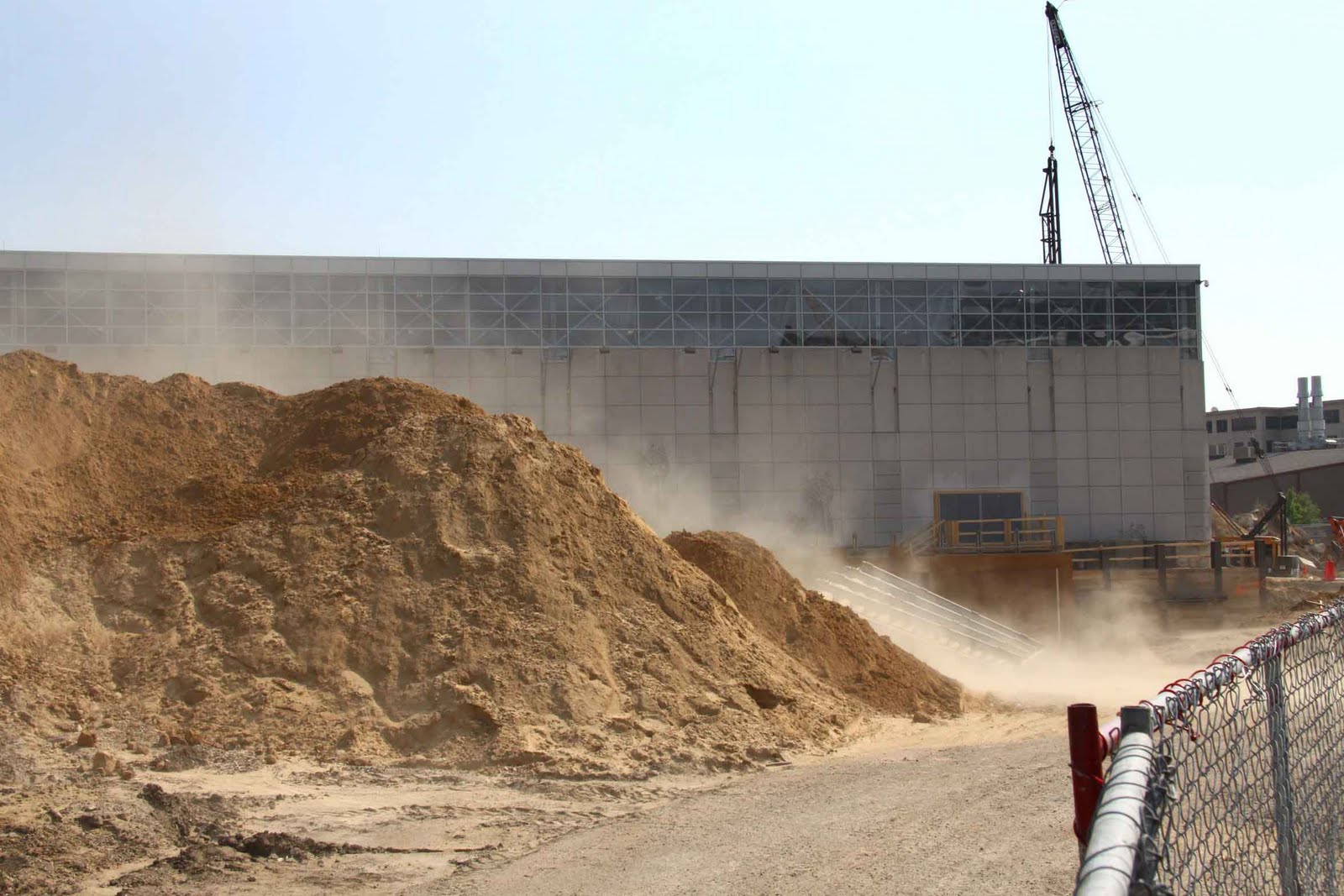
Findorff construction site next to Kohl Center, 6/3/11.
The American Lung Association said the Madison area is one of the worst places in the country for particle pollution in the air, according to a new study.
Saturday, April 30, 2011
Speedway releases concrete slurry to storm sewer
. . .
On or before April 24, Speedway Sand and Gravel was using a saw to cut concrete pavement on Highland Avenue.Water is required to cool the saw--and the water, plus concrete dust, creates an alkaline slurry. The slurry is so alkaline that it can cause a fish kill, upon reaching the lake.
Madison General Ordinances prohibit releasing concrete wastewater to the storm sewer.

Friday, April 29, 2011
Landgraf continues abuse from concrete mixing

Mixing of mortar for bricklaying at Mendota Court
creates toxic dust and alkaline runoff.
Wednesday, April 20, 2011
My grandma was a good inspector
Grandma gets the dirt on Findorff and Tri-North
. . .
So it goes with contractors and erosion control. During the last year of inspecting scores of construction sites, I've had a chance to test Grandma's method. It holds up pretty well.
If a construction site looks sloppy and disordered, then there's a good chance the erosion control has been neglected.
The silt fence--causes of failure
. . .
The silt fence is one of the most effective BMPs at construction sites. It acts as a dam along the perimeter of a site. Water pools behind the dam, while sediment settle out.However, in the year that I've been inspecting construction sites, I've seen a number of failures. These failures can be serious, because the silt fence is usually the last line of defense. Large amounts of impounded water and sediment can be suddenly released, causing a large sediment spill.
Inspectors should carefully inspect sediment fences, because they are so important, and because of ineffective installation, which is common.

When the fence fails, all that built-up water and sediment is released--causing a substantial "sediment spill."
Wednesday, April 13, 2011
Landgraf Construction dumps concrete wastewater to lake
Discharging concrete wastewater in the gutter is illegal. The water is highly alkaline, and can cause a fish kill.
Discharging such waste to the stormsewers is illegal in Madison. The Department of Health writes up violations and passes them to the City Attorney for prosecution.
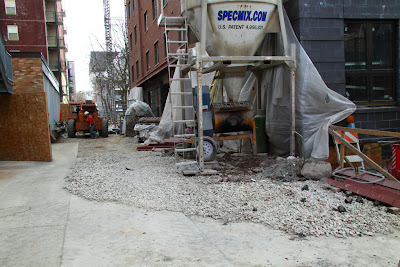
Discharging such waste to the stormsewers is illegal in Madison. The Department of Health writes up violations and passes them to the City Attorney for prosecution.

Landgraf Construction is mixing concrete products on-site at Mendota Court, just a block from Lake Mendota.
Monday, March 28, 2011
Mid Towne Construction wastes salt, pollutes lakes and groundwater
Levels of salt are rising in our lakes and groundwater. Salt use kills plants adjacent to roads and parking lots. Salt attacks concrete.
When companies like Mid Towne Construction store salt improperly, they not only harm the environment--they are also wasting your money.
When companies like Mid Towne Construction store salt improperly, they not only harm the environment--they are also wasting your money.

West Towne Mall, rear parking lot.
"Road salt use is a sleeping giant," said Roger Bannerman, DNR water resources management specialist. "The potential for chloride to damage our water systems is more inevitable than climate change." More
Tuesday, March 15, 2011
University snow dump could threaten Madison's aquifer

The University's snow dump is located close to an old fly-ash dump.
The huge pile of melting snow on University property, near Picnic Point, is a potential threat to Madison's aquifer and water supply.
Friday, February 18, 2011
Future Barriques cafe on Park St caught in illegal pumping
.
Barriques is known for their distinctive cafes that also serve wine--at five locations in the Madison area. A new store is being planned for 961 South Park St., where remodeling is underway. It's at the corner of S. Park and Parr streets, less than a block from Monona Bay. Environmentally, it's a sensitive location--Monona Bay is popular with fishermen.On Wednesday morning a local resident noticed a crew pumping a large volume of cloudy water from inside the site being remodeled. The water was flushed onto Parr St., where it flowed down the gutter and into a storm sewer, bound for Monona Bay. The resident said he recognized the man supervising the pumping as one of the owners of Barriques.

Illegal pumping onto Parr St. from Barriques future location.
The resident notified DNR personnel, who then contacted Rick Wenta, Public Health and Environmental Protection, under the City's Health Department. Update 2/21, based on email from R. Wenta:
"Generally, water from inside a structure is considered waste water, which has to be discharged to the sanitary sewer. (There are some exceptions; foundation water is one example.)
There are no provisions for filtering, then pumping the waste to the storm sewer. Under the state plumbing code, a floor drain collects domestic wastewater which must be directed to the sanitary sewer.
Public Health Madison and Dane County is responsible for enforcing Madison General Ordinance 7.46 which states: it is illegal to discharge potentially polluting substances to the storm sewer."
Next, a truck for pumping septic systems drove onto the site and began work. It wasn't clear weather their services had been previously planned by Barriques, or whether it was a response to the complaint.
That afternoon, Mr. Wenta inspected the scene of the illegal discharge. When notified that the resident had photos of the illegal pumping, Wenta said he would forward the information to the City Attorney, and that the Health Department would press for a fine.
What was in the water being pumped towards Monona Bay?
When I inspected the photos in photoshop, the water appeared cloudy and grey.


Click on photo to enlarge
Update 2/21: Mr. Wenta, who inspected the property after pumping ended, said he did not believe the cloudy water in the photo represented concrete slurry.
Neighbors are concerned about other toxic chemicals. At least three shops were formerly located at the site...
Neighbors are concerned about other toxic chemicals. At least three shops were formerly located at the site...
- A car radiator shop--heavy metals, antifreeze
- An auto repair shop--oil, antifreeze, & other fluids
- A furniture store with furniture repair--paint stripper (very toxic,) paint thinners, & lead
The resident who blew the whistle was worried about another possibility--that Barriques was pumping the sludge from the bottom of a drain trap--a concrete pit usually found in the floor of a building of this type. If so, that sludge could be contaminated with any of the toxins listed above.
Recently, Madison had a scare when toxic Chromium 6 (at very low levels) was found in the City's tapwater. Several years ago, a well on the near East Side had to be permanently shut down, because of industrial contamination. Concrete waste and wastewater contains significant amounts of Chromium 6.
Lessons from the incident at Barriques
- There may still be deposits of toxic chemicals lurking in old buildings. Remodeling or demolitions must be done with care and with inspections.
- Contractors and business owners--remember, citizens are watching. Madisonians care about their lakes.

The illegal hose was returned to this truck. Click photo to read plate.
Friday, January 7, 2011
Construction Co. Pays $60K Civil Penalty in Iowa
Manatt's is a private construction company hired to work on a portion of interstate in Iowa.
"Manatt’s approached the owner of private land adjacent to the I-35 construction project to seek permission to use material from the construction site to fill in approximately 1,000 linear feet of an unnamed tributary of White Breast Creek. Although the landowner agreed to the proposed activity, neither the landowner nor Manatt’s obtained a permit from the Corps of Engineers to allow the work within the stream and wetlands, as required by the federal Clean Water Act."
Manatt's unauthorized fill was spotted during a routine inspection by the Army Corps in 2009.
Source
"Manatt’s approached the owner of private land adjacent to the I-35 construction project to seek permission to use material from the construction site to fill in approximately 1,000 linear feet of an unnamed tributary of White Breast Creek. Although the landowner agreed to the proposed activity, neither the landowner nor Manatt’s obtained a permit from the Corps of Engineers to allow the work within the stream and wetlands, as required by the federal Clean Water Act."
Manatt's unauthorized fill was spotted during a routine inspection by the Army Corps in 2009.
Source
Tuesday, January 4, 2011
Speedway dumped hazardous waste in Lake Wingra

Misdeeds are sometimes revealed when bodies float to the surface... as happened recently at Lake Wingra.
Saturday, November 13, 2010
How phosphorus escapes from construction sites

When you see mud in the lakes, you know phosphorus is escaping.
Lake Mendota 7/7/10.
Lake Mendota 7/7/10.
Studies show that 19% of the phosphorus in our lakes--an important nutrient that causes the growth of toxic algae--comes from construction site erosion.Friday, November 12, 2010
Is dumping concrete waste illegal in Madison?
Concrete wastewater, and the slurry from cutting concrete with a saw, are very toxic to aquatic life. In addition, the waste contains chromium, a known carcinogen that can contaminate groundwater.
So... is dumping this material at a construction site illegal in Madison?
So... is dumping this material at a construction site illegal in Madison?
Rawson cleans mud from box culvert
Thanks to Rawson (and City inspectors) for cleaning the mud from the box culvert under Old Middleton Rd.
Now the mud won't move to the lake in the next big storm.

Tuesday, November 9, 2010
Concrete wastewater pollution in Madison
After I noticed concrete wastewater dumped at many construction sites around Madison, I decided to research the topic. Here's what I found... so far. Research in progress--your comments are welcome.


Concrete waste illegally dumped by Rawson Contractors close to Lake Monona at Lowell St. 11/7/10
Concrete wastewater is a white or grayish fluid. It comes from washing equipment used to mix or deliver concrete. It is often combined with a pile of leftover concrete. You can spot it as a white stain--on pavement, or on a prepared surface about to be paved.
Sunday, November 7, 2010
Rawson fails to clean mud from box culvert
The Rawson construction site on Old Middleton Rd is a mess--completely unprepared for rain. In their defence, no rain was forecast for the weekend. But much work remains to prepare for the rain forecast for next Thursday.
Wednesday, October 27, 2010
"Average" isn't good enough any more...

Madison--not an average city
The view--as Rawson Contractors pumped mud into Monona Bay.
"...Just doing your job in an average way — in this integrated and automated global economy — will lead to below-average wages. Sadly, average is over. We’re in the age of “extra,” and everyone has to figure out what extra they can add to their work to justify being paid more than a computer, a Chinese worker or a day laborer." Thomas FriedmanTuesday, October 26, 2010
Krupp--Please be a good neighbor!

The Sequoia Commons project, Phase II, is nearing completion.
On the whole, I have been satisfied with erosion control for this project. Except at the entrances, the site never sheds muddy runoff, and gravel pads were improved (N end) when I made suggestions.
Inaccurate inspection reports by City Engineering
Update 10/28, 10:00 am: Tim Troester has posted a new inspection for the Greenway project for 10/27. His accurate inspection adds important detail, including the time and photos. Therefore, I believe that Engineering is responding to my comments below, and that the situation is improving.
Accurate reporting is essential if our erosion control regulations are to work. They could provide the feedback that engineers and regulators need to see if their erosion control measures are working. And they are essential to holding contractors accountable to regulations.
Accurate reporting is essential if our erosion control regulations are to work. They could provide the feedback that engineers and regulators need to see if their erosion control measures are working. And they are essential to holding contractors accountable to regulations.
Inspection reports are legal documents. They need to be accurate and detailed enough to stand up in court, under cross-examination. Inspections by the City of Madison, for the most part, are neither accurate* nor detailed.
For that reason, some citizens have lost faith that contractors are accountable. That's why a lawsuit was filed by residents outraged by Speedway's behavior. And accountability is the reason for this blog. Our thousands of photos stand as accurate inspections. Each photo has a time stamp--in contrast to City inspections, which so far lack this basic element.
For that reason, some citizens have lost faith that contractors are accountable. That's why a lawsuit was filed by residents outraged by Speedway's behavior. And accountability is the reason for this blog. Our thousands of photos stand as accurate inspections. Each photo has a time stamp--in contrast to City inspections, which so far lack this basic element.
Yet Contractor Report has found instances of inaccurate inspections.
Subscribe to:
Posts (Atom)


